The following application notes document PTB functionality under real rail freight operating conditions.
All recordings were captured during Swiss DAC+ field trials. The videos provide direct operational evidence describing the test setup and illustrating automated train functions executed over PTB in operational environments, including shunting yards, long-distance routes and Alpine terrain.
Description of the field test system
(Application Note 1)
Start of the field tests
Tests of Train Functions
August 2023, after 2’460 km driving tests through Switzerland (Application Note 2)
Train Composition Detection
•Automatic topology reconstruction after each coupling / uncoupling event using the PLUS-TTD protocol
•Dynamic address allocation during train formation
Train Integrity Monitoring
•Continuous train integrity monitoring during drives via deterministic backbone communication (PLUS-TOKEN protocol).
•Monitoring data transmission from last wagon
Tests of Train Functions and summary of test results
September 2024 (Application Note 3)
Automated Brake Testing
•Deterministic communication for automated brake testing across the full train.
•PJM’s “WaggonTracker” signals transmitted via PTB to execute brake tests within seconds of initialization
•Communication between wagon control units and master tablet
Coupling and Uncoupling Operations
•Control and monitoring data exchange over PTB during automated coupling and decoupling procedures
•Push-button controlled decoupling
•Remote tablet-controlled decoupling
Tests of Train Functions and summary of test results
Summer 2025
Train Wake-Up and Passive Consist Detection
•Through integrated powerline monitoring and signalling mechanisms
•Train wake-up sequence over train power distribution cable
•Passive consist detection during train formation
Summary
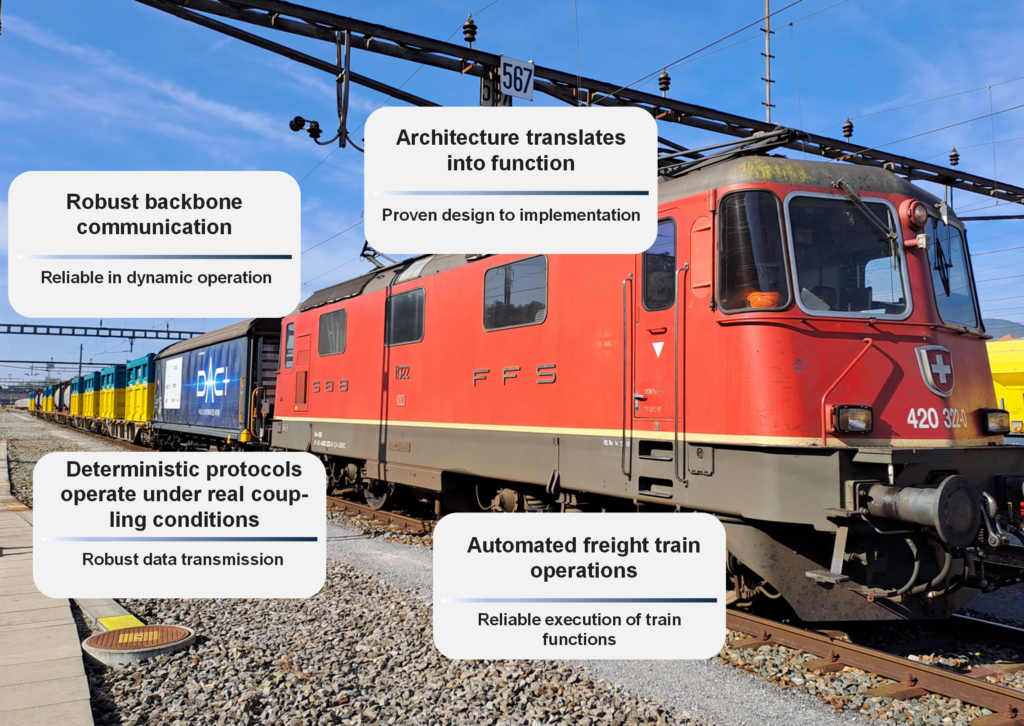
The application notes illustrate PTB functioning reliably as an operational train backbone in real rail freight environments. They provide documented evidence that:
•Architecture translates into function
•Deterministic protocols operate under real coupling conditions
•Backbone communication remains stable during dynamic operation
•Automated freight train functions can be executed reliably over PTB